
You’ve already said yes
The message comes through while you’re at work. Can you host this year? You type ‘Of course’ and go back to what you were doing. Later, when your partner asks what you’d like to do with the few days you have off, you realise you’ve already volunteered one of them. You can see how it happened. Your family usually asks you because you make it work.
You might be the person people turn to at the office, on shift or in a ward when something goes wrong. You probably make plenty of decisions in those settings without waiting for everyone to be pleased. At a family lunch you might find yourself watching one relative’s mood, filling a silence before it becomes awkward, or offering to drive someone home when you were looking forward to staying. Some of this is ordinary care. It’s worth noticing if there are people around whom helping feels like something you no longer get to decide.
Christmas brings several versions of family life together in one place. There are decisions about where to go, whose turn it is and what will happen if you change something that has been done the same way for years. If there’s been a separation, a death, or a shift in who needs care, the usual plan may no longer suit the people it was made for. The person suggesting a change can end up feeling responsible for the upset that was already there.
What the guilt is asking you to do
In Schema Therapy I’d ask what you expect to happen if you pause before saying yes. Two people can agree to the same thing for quite different reasons. One can picture their parent struggling and feels guilty leaving them to it. Another expects a pointed remark, an argument or days of silence if they say no. We’d consider self-sacrifice in the first example and subjugation in the second. Those are names for possible patterns. I’d want to hear enough about this particular family to know whether either one fits.
The distinction changes what we work on. If the guilt arrives when someone simply has to make a different plan, you may have some room to let it settle without taking the task back. If someone has repeatedly punished a refusal or made it unsafe to disagree, the work might involve deciding how much contact you want and who can support you. Discomfort is worth understanding in either case. It can mean you are doing something unfamiliar, and it can also be an accurate response to how someone has treated you.
In one study of psychiatric outpatients, Jens Thimm found links between scores on early maladaptive schemas and recurring interpersonal difficulties. The study looked at those patterns together, so it can’t tell us which came first. In therapy I’d also want to know when you’re able to ask for what you need and what’s different with those people.
Change one part of the arrangement
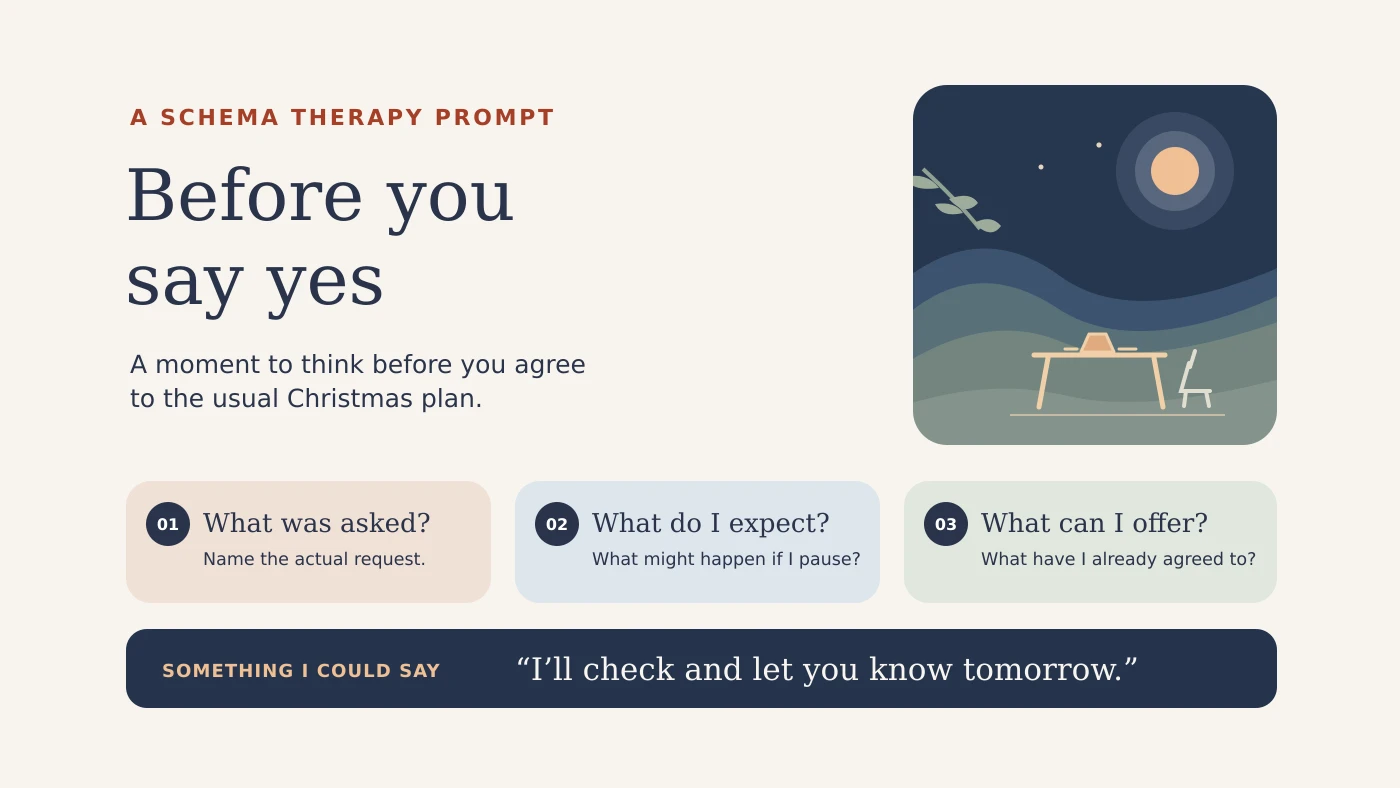
Start with a decision that belongs to you and feels safe enough to make. If the family is accustomed to you hosting, it might be ‘I can bring lunch, but I can’t host this year.’ If you’re already going and expect to be asked a question you’d rather leave alone, try ‘I’d rather leave that for another day.’ A pause can be enough the first time. ‘I’ll check and let you know tomorrow’ gives you a chance to see what else you’ve agreed to before you answer.
Before you reply, make a brief note of what you expect will happen. Perhaps you think a sibling will be angry, and you’ll have to ring later to smooth things over. Once you’ve replied, separate what happened from what you feared, including what you had to manage afterwards. A relative might be disappointed and make another arrangement. They might push back and the guilt might last for a while. Both outcomes give you more to go on when making the next decision.
Some arrangements require a different level of planning. If there is intimidation, violence, or a credible risk of retaliation, discuss the options with someone you trust or a specialist support service before making a change. It may be safer to organise your own transport, arrange contact in a different setting or decide not to go. You don’t have to use a family gathering to test whether someone will respect your limits.
What I’d want to understand in therapy
I’d start with a recent example and go slowly through the moments before you agreed. What did you notice about the other person? What did you feel you owed them? What were you giving up that you hadn’t yet had a chance to think about? We can also look for examples of care that felt freely given. That gives us some idea of what you’d like to keep, including the parts of your role you value.
If the same thing happens every year, the family group chat may be a useful place to start. A single ‘I’ll let you know tomorrow’ can give us something quite specific to talk about. What you decide the next day is still yours.
Research drawn on
- International Society of Schema Therapy. Model overview. Schema Therapy Central Concepts. View source
- Thimm JC. International Journal of Psychology and Psychological Therapy. 2013;13(1):113–124. Early maladaptive schemas and interpersonal problems. View source
AI disclosure
Brent Munro researched, wrote and reviewed this insight, with ChatGPT assisting in literature searches, limited research comparisons, editing and image generation. He retains full responsibility for the published content.